Most pages about mining are written to sell you something. This one is written so you can decide properly — including deciding not to buy. Everything below is checkable, and the sources are at the bottom.
The short version, in six lines.
Imagine a guessing game that never stops. Every second, a network of computers is asked to guess a very large number. There is no cleverness involved — the only way to find it is to try billions of guesses. Whoever guesses first gets to add the next page to the shared record book, and is paid a reward in that coin for doing it.
Your machine is simply a fast guesser. A graphics card is good at this because it can make many guesses at the same time — that is the same ability that makes it good at drawing video game scenery.
Two things follow from this, and they explain almost everything else on this page:
If your machine makes one guess in every million on the network, you earn about one millionth of the rewards. If everyone else buys faster machines, your share shrinks — even though your machine has not changed at all.
The machine runs all day and all night. Electricity is the running cost, and in Hong Kong it is a serious one. This is the number that decides whether mining makes sense for you.
If you last looked at mining a few years ago, the picture has changed twice since then. Both changes were bad for graphics cards.
In September 2022 Ethereum switched off mining entirely and moved to a different system. Before that, Ethereum was more than 95% of all graphics-card mining income. It disappeared in a single day, and every card in the world went looking for somewhere else to go.
Manufacturers began building ASICs — machines built to do one single calculation and nothing else. They cannot browse the web or play a game; they do one sum, extremely fast, for less electricity. Wherever an ASIC is built for a coin, graphics cards stop being competitive on that coin within about a year.
What is left for graphics cards is a handful of smaller coins that have deliberately kept ASICs out. Margins are thin everywhere, and electricity price now separates the people who make money from the people who do not.
If you remember nothing else from this page, remember this. It is the difference between a machine that earns and a machine that only costs.
A graphics card is a general-purpose tool. An ASIC is a machine built for exactly one calculation. Think of the difference between a good kitchen knife and a factory machine that does nothing but slice carrots. For slicing carrots, the factory machine wins by a distance that is not worth arguing about.
Here is the real scale of it. On Kaspa, one current ASIC produces about 21,500 GH/s. One of our graphics cards produces about 0.215 GH/s:
One Kaspa ASIC does the work of roughly 100,000 of these graphics cards. The whole Kaspa network is now around 267 PH/s. A single card is about one two-billionth of it. That is why a card mining Kaspa earns effectively nothing — not a small amount, but an amount too small to matter, whoever sells you the machine and however well it is tuned.
This is also why a coin being popular or going up in price tells you nothing about whether you can mine it. Kaspa is a real project with real users. It is simply no longer something a graphics card can mine.
So the first question about any coin is never "is it a good coin?" It is "who am I competing against?"
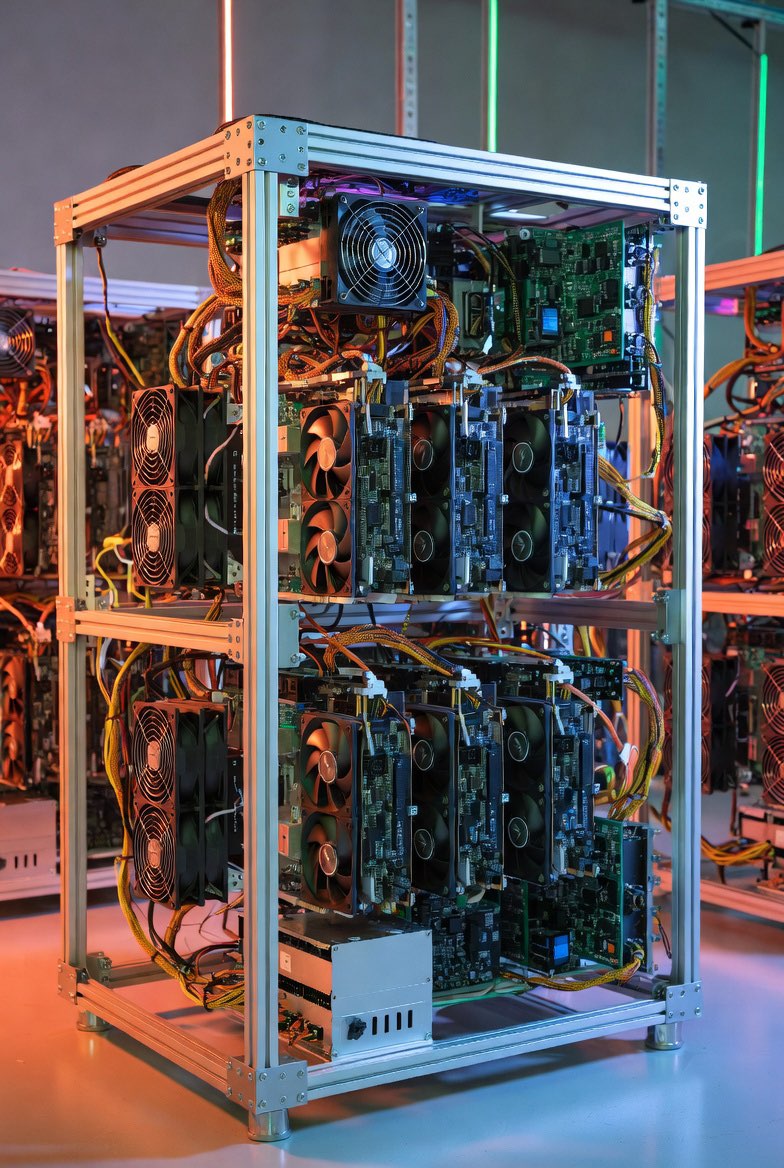
A graphics card is a general tool. That is its weakness against an ASIC — and its advantage after mining ends.
Every coin we are regularly asked about, and a straight answer on each. "Competing against" is the column that matters.
| Coin | Algorithm | Competing against | Suits this card | What you should know |
|---|
A note on the two we removed from the top of the list. Earlier versions of this website presented Kaspa as the best coin to mine on our machines. That was based on the card's raw speed, which is genuinely high on Kaspa — but it ignored who else is on that network now. It was wrong, it is corrected, and we would rather tell you plainly than quietly change it.
Four things, in order of how much they matter. Notice that the machine you buy is not the first of them.
A mining machine runs 24 hours a day. Over a year, the electricity usually costs more than the machine did. Every cent per unit changes the answer. This is the whole game.
Called the difficulty. When more people mine a coin, everyone's share falls automatically. You cannot influence it and you cannot predict it.
You are paid in the coin, not in dollars. If the coin falls, your earnings fall with it. Nobody knows where any of these prices are going, and anyone who says they do is selling something.
A machine that is switched off earns nothing. In practice heat and noise are what make people switch machines off, so where you put it matters more than people expect.
We deliberately do not publish income projections here. Coin prices and difficulty both move constantly, so any figure we printed would be wrong within weeks — and printed on a page like this it would look like a promise. Our electricity calculator lets you put in your own tariff and see the cost side for yourself, which is the part that is actually predictable.
This is the section most mining sellers leave out. Hong Kong has some of the more expensive electricity in the region, and that fact governs everything.
| Where your power comes from | HK$ per unit | What it means for mining |
|---|
At standard residential tariffs, mining these coins loses money. Not marginally — clearly. The electricity to run a machine for a day costs several times what the machine mines in that day. That is true of every coin on this page, and it is true whoever you buy the machine from.
It is also not a Hong Kong quirk. Across the industry, the rough line where graphics-card mining stops working is around US$0.15 per unit. CLP is about US$0.18 and HK Electric about US$0.21.
Here is the number that matters most on this page. On our own calculator, a BlockYield V4 mining Ravencoin needs electricity under about HK$0.27 per unit just to cover the power it burns. Nothing in the table above is below that. Rooftop solar at around HK$0.28 comes out roughly level — it pays for the electricity and nothing more. Hosting is closer than the grid, but still negative today.
One machine puts out about as much heat as a small electric heater, all day. In an air-conditioned flat you pay once to make that heat and again to remove it — roughly a third more on top.
These machines are as loud as a running dishwasher and never stop. That is manageable in a utility room and intolerable in a bedroom or a shared flat.
Some leases restrict high-draw equipment. Older flats may not have a spare circuit that will take a continuous load. Both are worth checking before, not after.
Mining cryptocurrency for yourself is lawful in Hong Kong. The licensing regime the government has been building — and the further rules planned for 2026 — applies to exchanges, dealers and custodians who handle other people's assets. It does not require a licence to run a machine you own.
If the Inland Revenue Department regards your mining as a trade or business rather than a hobby, profits sourced in Hong Kong can fall under Profits Tax, currently 8.25% to 16.5%. Frequency and scale are what tip the balance.
We build and service hardware. We are not your accountant or your solicitor, and none of this is tax or legal advice — if you are going to run more than one machine, ask a Hong Kong practitioner first.
A straight answer, because the wrong buyer costs us more in support and returns than the sale was ever worth.
Read the left-hand column carefully. It is not a list of ways to turn a profit at today's prices — on the numbers above, none of them quite do. It is a list of situations where the electricity stops being the problem, so what you are really left with is a bet that the coins you collect, plus what the hardware is still worth later, come to more than you paid. That may work out. It is a bet, and we would rather call it one.
We mean it. Tell us your situation and we will tell you honestly whether it works, including when the answer is no. We would rather have your trust and no sale today than a machine returned in three months.
Whatever happens to any coin, you still own eight graphics cards. They can be resold, put into a workstation, used for video work, three-dimensional rendering or running AI models locally. Demand for used cards has recovered considerably since the 2022 crash, largely because of AI. A mining machine holds more of its value than most electronics — which is worth remembering when you compare it against something with no resale value at all.
Every term on this page, explained the everyday way.
Checked in August 2026. Mining figures move — if you are reading this much later, check them again rather than trusting this page.
Nothing on this page is investment advice or a forecast. We sell hardware; we do not sell an outcome, and we do not know where any coin price is going.
